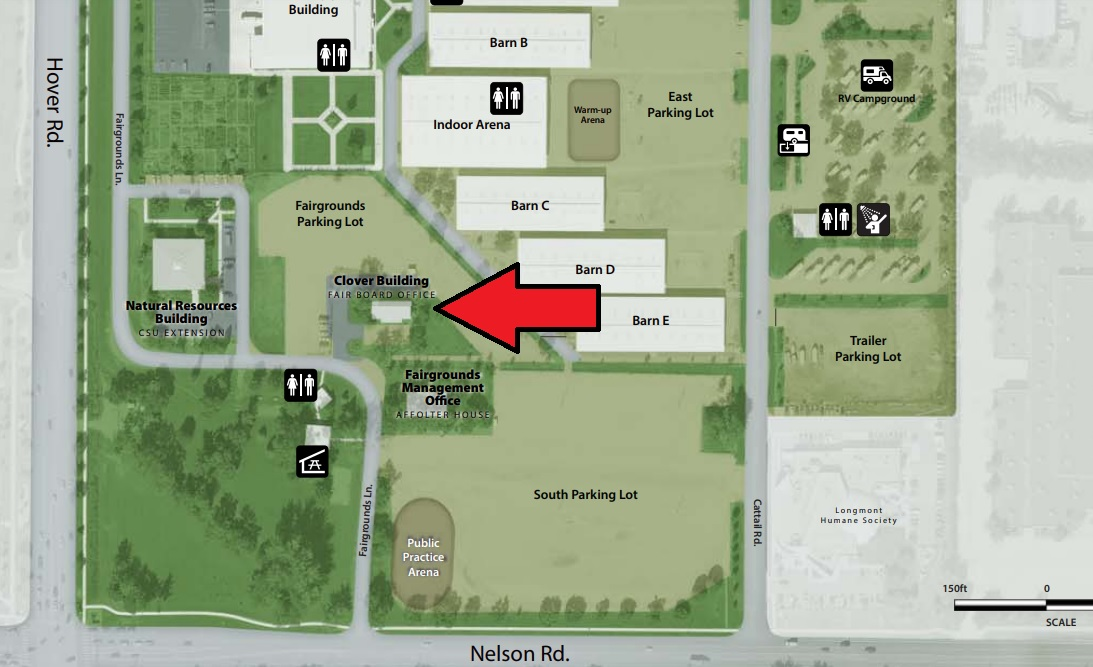
Meshtastic or MeshCore or Reticulum and ATAK
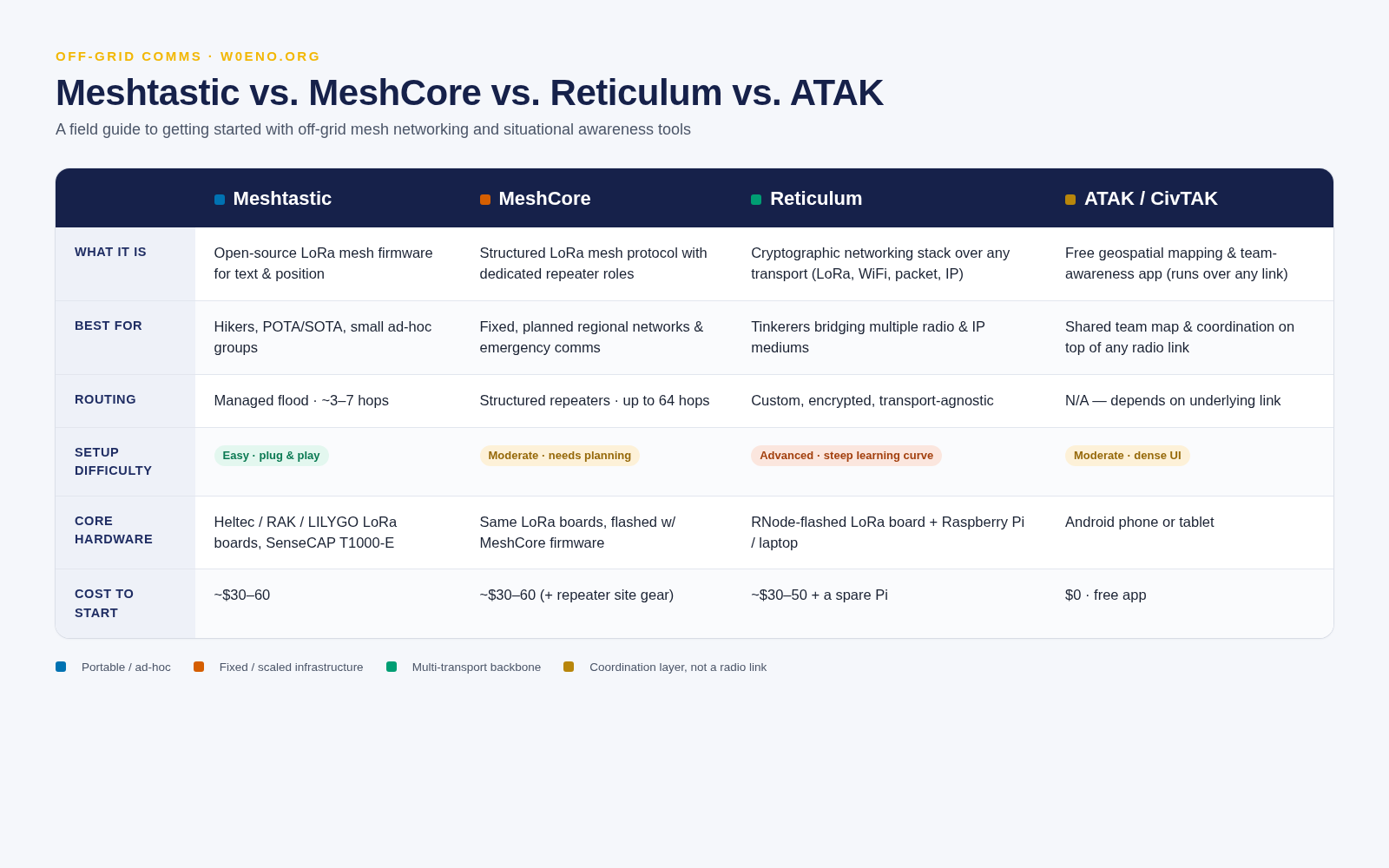
At-a-glance comparison — details and getting-started steps below
Off-Grid Comms Compared: Meshtastic vs. MeshCore vs. Reticulum vs. ATAK
A guide for hams getting started with off-grid data networking
If you’ve been to a hamfest, a POTA activation, or a Field Day site in the last couple of years, you’ve probably heard someone mention “Meshtastic nodes” or seen a phone running ATAK. These tools sit alongside traditional amateur radio — voice, CW, digital modes — as a new layer of off-grid, internet-independent communication. This article breaks down four of the most talked-about systems, what makes each one different, and what it takes to get on the air (or on the mesh) with each.
Quick framing before we dive in: these are complementary tools, not competitors. Many hams run two or three of them at once — a Meshtastic node clipped to a backpack, a MeshCore repeater on a hilltop, and ATAK on a phone for situational awareness during an event. None of them replace your license privileges; using them over amateur frequencies with amateur callsigns follows the same Part 97 rules as any other mode.
1. Meshtastic — the easy on-ramp
What it is: Meshtastic is an open-source firmware for cheap LoRa (Long Range) radio modules that turns a handful of them into a self-organizing text-messaging mesh network — no cell service, no internet, no infrastructure required. Every node can also act as a repeater, rebroadcasting messages up to a configurable hop limit (typically 3–7 hops).
How it works: Nodes pair to a phone app (Android/iOS) or web client over Bluetooth, WiFi, or USB. You send short text messages, GPS position, and telemetry over unlicensed ISM bands (915 MHz in the US) using a “managed flood” routing scheme — simple, but it can get chatty on busy networks.
Best for: Hikers, POTA/SOTA activators, festival and event groups, small ad-hoc teams, and anyone who wants zero-config mesh messaging in the field. This is by far the easiest of the four to get running in an afternoon.
Getting started — what you need:
- A Meshtastic-compatible LoRa device. Popular entry points:
- Heltec V3 / T-Echo / RAK WisBlock — classic budget-friendly boards with small screens (~$25–45)
- SenseCAP T1000-E — a compact clip-on tracker, great as an everyday-carry node
- Seeed Studio Wio Tracker L1 / L1 Pro — more extensible, good for mobile/vehicle use
- Station G2 / solar-powered boards — for a fixed, always-on hilltop repeater
- Budget dev-kit option: XIAO ESP32-S3 or XIAO nRF52840 with a LoRa module, if you want to build your own
- A phone or laptop with the free Meshtastic app
- A US-legal 915 MHz antenna (stock whip is fine to start; upgrade later for range)
- Optional: a solar panel + small battery for a fixed repeater node
Cost to start: roughly $30–60 for one handheld node; a two-node starter pair is a great first purchase for the club to demo at meetings.
2. MeshCore — built for bigger, planned networks
What it is: MeshCore is a newer (2025) LoRa mesh protocol, built partly in response to Meshtastic’s growing pains at scale. Instead of every node blindly rebroadcasting, MeshCore uses dedicated device roles — clients, repeaters, and room servers — and a more structured, hierarchical routing model.
How it’s different from Meshtastic:
| Meshtastic | MeshCore | |
|---|---|---|
| Routing | Managed flood, all nodes can repeat | Structured, dedicated repeater roles |
| Max hops | ~3–7 | Up to 64 |
| Best environment | Mobile / ad-hoc (hiking, activations) | Fixed, planned infrastructure (city/regional coverage) |
| Delivery confirmation | Limited | Built-in confirmed delivery |
| Setup effort | Plug-and-play | More planning, but scales much better |
| Hardware | Same LoRa radios as Meshtastic (different firmware) | |
The short version circulating in the community: Meshtastic is best for small, mobile, ad-hoc groups; MeshCore is best for larger, organized, semi-permanent networks like a county-wide emergency comms backbone or a club’s repeater network. Several regional mesh groups have reported better long-range reliability after switching their fixed infrastructure to MeshCore, while keeping Meshtastic on portable/handheld gear.
Getting started — what you need:
- The same LoRa hardware as Meshtastic (Heltec, RAK, LILYGO, T-Echo, etc.) — you simply flash MeshCore firmware instead. Note: a node can only run one firmware at a time; it’s not cross-compatible with Meshtastic devices on the air.
- MeshCore companion app (Android/iOS) or web flasher
- If you’re setting up a repeater: a rooftop/hilltop mounting location, a better antenna (5–8 dBi gain fiberglass), and ideally solar/battery power for continuous uptime
- A plan — MeshCore rewards a bit of network design (where repeaters go, what room servers handle traffic) rather than pure plug-and-play
Cost to start: Same $25–45 hardware range as Meshtastic since it runs on identical boards — the difference is mostly in planning, not price.
Club angle: If LARC wants to build out a Longmont-area or Front Range backbone (useful for Field Day, POTA support, or ARES-style emergency backup comms), MeshCore’s repeater-role model is arguably the better long-term architecture than a flat Meshtastic flood network.
3. Reticulum (RNS) — the deep end, for maximum flexibility
What it is: Reticulum is not really a “mesh radio protocol” in the same sense as the other two — it’s a cryptography-based networking stack that can run over almost any transport medium: LoRa (via RNode hardware), WiFi, Ethernet, packet radio (AX.25/KISS TNCs), serial links, or plain TCP/IP over the internet. Think of it less like “another Meshtastic” and more like a DIY, censorship-resistant version of the internet’s networking layer, purpose-built for encrypted, decentralized comms.
Why hams are interested: Reticulum can bridge disparate hardware into one network — e.g., a Raspberry Pi with a LoRa RNode, a packet-radio TNC, and a WiFi link can all be part of the same encrypted mesh simultaneously. It’s the most flexible and most “future-proof” of the three data protocols, but it has a real learning curve — you’re setting up a network stack, not just flashing a firmware and pairing over Bluetooth.
Applications people run on top of it:
- Sideband — a full-featured messaging/mapping/voice app (Android/desktop)
- Nomad Network — terminal-based messaging and file sharing
- Mesh Chat — simpler browser-based chat client
Getting started — what you need:
- RNode-compatible hardware for the LoRa side — this can be a Heltec/LILYGO LoRa board flashed with RNode firmware (same class of hardware as Meshtastic/MeshCore, again), or a purpose-built RNode
- A host device to run the Reticulum daemon: a Raspberry Pi (very common choice), an old laptop, or even a phone (Sideband runs standalone on Android)
- Reticulum software:
pip install rns(Python-based), then configure interfaces in the RNS config file - Optional but recommended: a packet radio TNC or spare WiFi/Ethernet gear if you want to experiment with bridging multiple transport types
- Patience — expect to spend real time reading the docs (markqvist.github.io/Reticulum) and the Reticulum manual’s hardware page before it “just works”
Cost to start: $30–50 for an RNode-flashed LoRa board plus whatever compute you already have lying around (an old Raspberry Pi is perfect). Software is free and open source.
Best for: Technically-minded members who want to understand the plumbing, build custom infrastructure, or bridge amateur packet radio with LoRa and IP networks in one unified, encrypted mesh. Great fit for a “digital modes deep dive” club presentation.
4. ATAK / CivTAK — situational awareness on top of any of the above
What it is: ATAK (Android Team Awareness Kit), known as CivTAK or ATAK-CIV in its civilian-legal form, is a free, open-source geospatial mapping and team-collaboration app originally developed by the Air Force Research Laboratory. It’s not a radio protocol — it’s the display and coordination layer that sits on top of a data link (which can be Meshtastic, MeshCore, packet radio, WiFi, cellular, or plain internet).
What it actually gives you:
- Real-time team location tracking (“PLI” — Position Location Information) on a shared map, online or fully offline
- High-resolution offline maps and imagery, drawing/marking tools, and route planning
- Group chat, file/photo sharing, and “team emergency beacon” alerts
- Overlay support for KML/KMZ/GPX files — handy for course maps, coverage plots, or repeater location overlays
- A plugin architecture — this is the key piece for hams: there are ATAK plugins that bridge it to Meshtastic devices, letting node positions and messages show up directly on the ATAK map instead of a separate app
Why it matters for a radio club: For an event like a POTA activation, Field Day, or a public-service/ARES-style deployment, ATAK gives you the “common operating picture” — everyone’s location and status on one shared map — while Meshtastic/MeshCore/Reticulum handles the actual radio data link underneath it. Some clubs also use it for Boy Scout events, SAR-style exercises, or simply tracking activators/loggers across a large multi-op Field Day site.
Getting started — what you need:
- ATAK-CIV, free on the Google Play Store (Android 5.0+) — the civilian-legal build; do not use military-restricted ATAK builds
- An Android phone or tablet per user (iOS support is limited/community — plan on Android for full features)
- Offline map tiles for your area, downloaded in advance (no internet needed once loaded)
- If bridging to a radio mesh: a Meshtastic (or other) plugin/bridge configured to feed position/chat data into ATAK
- Expect a learning curve — the interface is dense and originally built for military use; budget a training session or two before your first event
Cost to start: $0 for the software; cost is just whatever Android devices your members already carry.
Putting it together: a suggested path for LARC members
| If you want to… | Start with |
|---|---|
| Try mesh messaging cheaply and easily on a hike, POTA activation, or Field Day | Meshtastic — one or two nodes, ~$60 total |
| Build permanent, scalable coverage across Longmont/Boulder County | MeshCore repeaters on hilltop sites + Meshtastic-class handhelds for portable users |
| Bridge packet radio, LoRa, and IP into one encrypted network, or just like to tinker | Reticulum on a Raspberry Pi + RNode |
| Track team positions and coordinate a multi-operator event on a shared map | ATAK-CIV, layered on top of whichever radio link the team is using |
A practical, low-cost club demo kit: 3–4 Meshtastic nodes (mixed handheld + one solar fixed node), one Android tablet running ATAK-CIV with the Meshtastic bridge plugin, and a short “bring your phone” session at a meeting. That combination alone showcases all four technologies working together without a huge budget.
Have questions about any of these systems or think it would benefit the club to build a Go-Box? Reach out to me — Send Email to K0ITP.


 The Custom Facebook Feed plugin